
The SMS That Stole Everything: The Rise of Malicious APK Scams in Malaysia
Imagine this: You get a text message—it looks official, maybe from Pos Laju about a missed parcel, or perhaps a chilling notice about a hefty traffic summons. A sense of urgency makes you click the link to “pay online” or “track your delivery.” You download a small file, and run the installation…
In that instant, you didn’t just install a legitimate app; you welcomed a professional thief into your Android smartphone.This isn’t a hypothetical threat; it’s a reality faced by thousands in Malaysia. MyCERT has highlighted an alarming spike in localized Malicious APK scams, expertly designed to target our reliance on mobile services and, specifically, our bank accounts. This threat is now one of the top reported malware incidents.
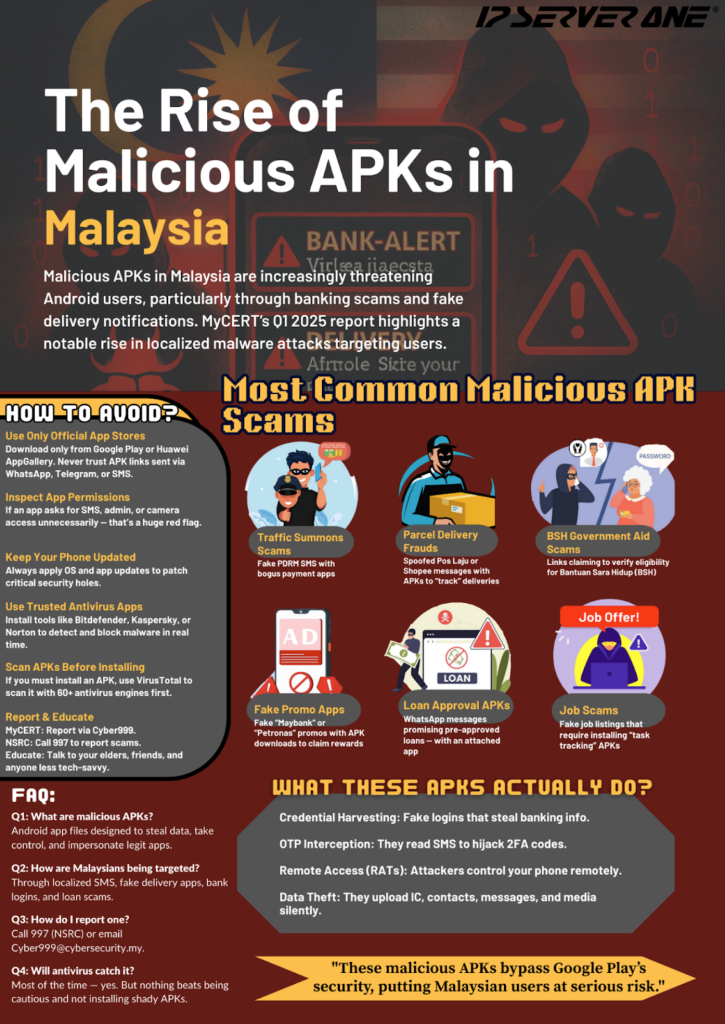
What is a Malicious Android Package (APK)?
An Android Package (APK) file is the standard format used to distribute and install applications on Android devices. A Malicious APK is essentially a Trojan horse—a file containing malware designed to harm devices, steal data, or perform unauthorized actions.
These malicious versions often mimic popular apps (e.g., social media, games, or utilities) to trick users. They exploit the manual installation process, bypassing the strict security checks of official app stores. Once installed, they demand excessive permissions that allow them to execute banking fraud and data theft.
The Scale of the Threat (Q1 2025)
According to MyCERT reports, Malicious APKs are the top reported malware incidents, often linked directly to internet banking users and local financial institutions.
The top malware incidents include malware hosting, ransomware, malicious APK, backdoors, and trojans. The top reported malware incidents are related to malicious APKs.
| Types of Malicious APK Reported in Q1 2025 | Total |
| ???pdf.app.apk | 1 |
| helpling COD | 2 |
| Encik Beku COD | 1 |
| cleaning service | 3 |
Meet the Scammers: The Faces of Mobile Fraud
These criminals are masters of disguise, utilizing high-pressure, believable scenarios to trick you into granting them the keys to your digital life. Understanding their favorite masks is the first step in fighting back against this insidious mobile scam:
| Scam Type | The Hook | What Happens Next |
| Traffic Summons Scams | A fake SMS warning about an overdue fine. | You download an APK to “view details,” which instantly installs remote access tools (RATs) to control your phone. |
| Parcel Delivery Scams | A text from a fake courier company about a delivery that requires a special “tracking app.” | The malicious APK harvests your bank login credentials when you enter them on a fake payment page. |
| Loan Approval Scams | A tempting pre-approved loan offer requiring you to download a “companion app” to process the funds. | The APK silently intercepts your OTP (One-Time Password) messages, allowing the criminal to empty your accounts. |
| BSH / Government Aid Scams | A link claiming you must verify your eligibility for federal assistance (like BSH). | The app steals your identity data, paving the way for further identity and financial attacks. |
What Do These Malicious APKs Actually Steal?
These apps are sophisticated tools designed for maximum destruction:
- Your Credentials: They present fake, identical login screens to capture your banking app passwords.
- Your Money: By intercepting your 2FA and OTP messages, they bypass critical security measures, giving them full transaction control.
- Your Privacy: They use excessive permissions to upload all your contacts, photos, and private chats from your phone, setting the stage for blackmail or identity theft.
Real-Time Threats: MyCERT Advisory Case Studies
These examples from official MyCERT advisories show the real-world impact of these localized campaigns:
| Date | Campaign Name | Modus Operandi and Impact |
| 15 Oct 2023 | MyBayar PDRM Phishing Website | Modus Operandi: Fake MyBayar PDRM sites (via SMS/social media) lure users to “pay a small fine.” Impact: The site is a phishing tool that harvests bank card numbers, CVVs, and expiry dates—not just for the fine, but for future major fraud. |
| 16 Sep 2022 | MyPetronas Malicious Application | Modus Operandi: Fraudulent websites impersonate Petronas offering tempting service deals, directing victims to download a malicious APK to book. Impact: The APK steals bank login credentials and intercepts SMS/OTP codes, leading to financial loss and Personal Identifiable Information (PII) disclosure. |
| 07 Feb 2022 | SMSSpy campaign to steal Malaysian banking user credential | Modus Operandi: Scammers impersonate law enforcement, instructing victims to download an app (like SMSSpy) to complete a payment or clearance process. Impact: The malware steals banking login details and, critically, intercepts all incoming SMS, enabling large, unauthorized bank transactions. |
Say NO to APK: 5 Rules for Android Security
Security isn’t complicated; it’s about forming strong habits. You are the ultimate defense against this mobile scam.
- Strictly Official Sources Only: NEVER install an application from a link sent via SMS, WhatsApp, or Telegram. Only download apps directly from the trusted Google Play Store or Huawei AppGallery.
- Inspect Permissions Like a Detective: Does a simple courier tracking app really need access to your contacts, SMS, and camera? NO. If the permissions requested are suspicious or excessive, DENY THE REQUESTS AND DELETE THE APP IMMEDIATELY.
- Keep it Current: Always update your operating system and apps. Updates frequently patch the critical security flaws that scammers exploit.
- Arm Your Device: Install and maintain a reputable mobile antivirus tool (like Bitdefender or Kaspersky) to help detect threats that slip through the net.
- Report and Educate: If you receive a suspicious message, report it to MyCERT / Cyber999. Then, tell your friends and family—especially the less tech-savvy—so they don’t fall prey to the same banking fraud.
Remember the Golden Rule of Android Security: Malicious APKs only win when you give them permission to install. If you skip the official app store, you put your entire digital life at risk.
Key Takeaways: Protect Your Mobile Life Today
The threat of Malicious APKs is real, but your vigilance is the strongest defense. Keep these three critical points in mind every time you use your phone for mobile banking or communication:
- Stop the Download Source: If the link is in an SMS, WhatsApp, or any communication outside of the official Google Play Store or Huawei AppGallery, DO NOT CLICK IT. Assume any unexpected text message requiring a download is a mobile scam.
- Verify, Verify, Verify: Never trust a single message claiming to be PDRM, Pos Laju, or your bank. If you receive an urgent notice, close the message and independently verify the claim by calling the official organization’s known contact number or checking their official website.
- Control Your Permissions: An app that demands access to your SMS, contacts, and photos to perform a simple, unrelated task (like checking a summons) is a malicious app. Deny those permissions and uninstall it immediately.
Don’t let a single, careless click lead to financial catastrophe. Stay alert, stay secure.