

Customer Stories at IP ServerOne
How Mechanical Engineers Run CFD Simulations Faster & Cheaper
Powered by: NovaCloud
Powered by: NovaCloud
CFD simulations are highly resource-intensive, demanding significant processing power, memory, and storage. Local workstations often struggle with large simulation datasets, leading to long computation times and restricted model complexity. Investing in on-premises hardware is costly, requires ongoing maintenance, and lacks flexibility when project demands change.
By leveraging NovaCloud’s high-performance virtual machines and scalable resources, engineers and students can run CFD simulations in the cloud without hardware bottlenecks. NovaCloud allows users to:
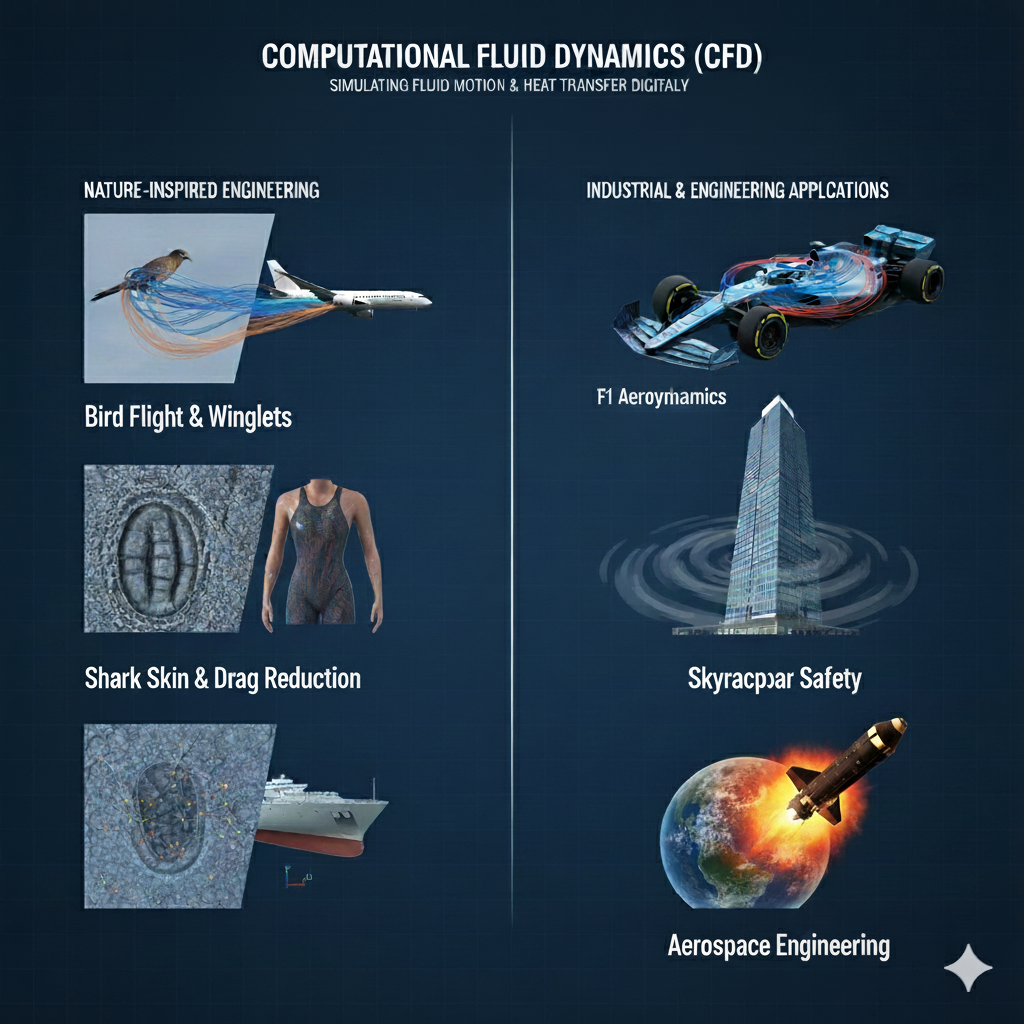
Have you ever wondered how birds defy gravity? Why do airplanes take on their iconic curved wing shapes? Or how a Formula 1 car can hug a corner at 300 km/h without losing grip?
The answer lies in Computational Fluid Dynamics (CFD). For mechanical engineering students like King Wei from Monash University, CFD transforms complex mathematical equations into practical insights that drive real-world engineering innovation. Today, with NovaCloud, students in Malaysia can run advanced CFD simulations using cloud computing—without investing in expensive hardware.
At its core, Computational Fluid Dynamics simulates how fluids—air, water, and other gases or liquids—flow, transfer heat, and interact with solid surfaces. By breaking down a physical space into a fine digital mesh, engineers can predict real-world behavior and optimize designs before building physical prototypes.
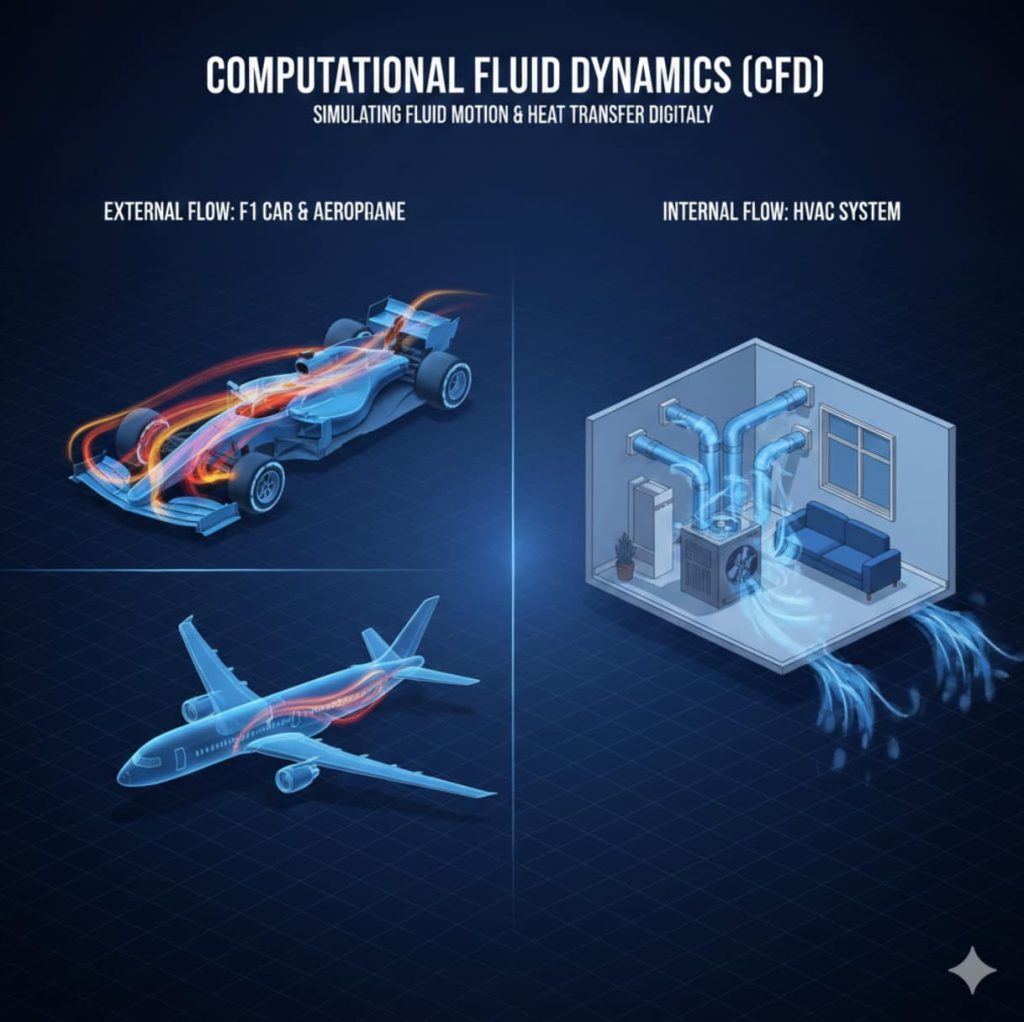
Think of CFD as a virtual wind tunnel. Instead of constructing costly experimental setups, mechanical engineers visualize invisible forces digitally. This approach is widely used across aerospace, automotive, civil engineering, and industrial design.
Computational Fluid Dynamics (CFD) is built on the Navier–Stokes equations, which describe the motion of fluids by linking velocity, pressure, temperature, and density. First formulated in the 1800s, these equations are elegant in theory—but notoriously difficult to solve.
For complex geometries like aircraft wings or car bodies, solving them requires huge computational power. This is where many students hit a wall: a standard laptop simply isn’t enough.
CFD isn’t limited to classrooms or laboratories—it influences everyday life in surprising ways.
In the past, CFD calculations were painfully slow. Engineers relied on limited computing resources, long runtimes, and often compromised on accuracy. For students, running large simulations could be frustrating—or simply impossible.
Cloud computing has changed that.With NovaCloud, students can access high-performance computing resources on demand, enabling them to run millions of calculations in a fraction of the time.
NovaCloud by IP ServerOne provides scalable, high-performance cloud infrastructure optimized for workloads like computational fluid dynamics (CFD). It removes the biggest barriers to learning and experimentation for mechanical engineering students in Malaysia.
Here are six reasons NovaCloud is ideal for CFD workloads:
CFD projects often involve fine meshes, turbulence models, and transient simulations that demand high CPU core counts and large amounts of RAM. NovaCloud allows students to run airflow, heat transfer, and multiphase simulations without relying on costly workstations.
Long solver runtimes are a common challenge in CFD. NovaCloud lets students temporarily scale up CPU cores, helping simulations converge faster—especially for:
This means less waiting and more time for analysis and learning.
CFD is rarely a one-time process. Students often refine meshes, adjust boundary conditions, or test different geometries. NovaCloud makes it easy to run multiple simulation iterations in parallel—critical when working under tight academic deadlines.
Fine mesh resolution improves accuracy but quickly overwhelms local machines. NovaCloud’s RAM-optimized instances allow students to:
CFD simulations represent hours—or days—of computation. NovaCloud’s high-availability infrastructure and snapshot backups protect meshes, solver outputs, and post-processing files, reducing the risk of data loss during critical project phases like final-year submissions.
Unlike global cloud providers, NovaCloud offers 24/7 Malaysian-based technical support.
King Wei’s project required high-fidelity simulations far beyond the capabilities. Here’s how he leveraged NovaCloud:

Deployed an Ubuntu instance on NovaCloud and installed open-source tools such as FreeCAD (modeling) and Salome/GMSH (meshing).

Divided the geometry into fine grids to ensure simulation accuracy.

Ran OpenFOAM on a high-core NovaCloud instance to calculate fluid behavior.

Visualized and processed results using ParaView and Python.

Scaled resources up during computation and down when idle to control costs.
This workflow allowed him to focus on engineering insights—rather than hardware limitations.
The Cloud for Students Program by IP ServerOne is created to give Malaysian students free access to cloud computing resources for learning, experimentation, and project development.
With this program, students can focus on learning, experimenting, and innovating—without worrying about cost and hardware constraints. From CFD and robotics to other compute-intensive projects, NovaCloud empowers Malaysian students to push their engineering skills further.
👉 Learn more about