
VPS vs Cloud Hosting 2026: Which is Best for Malaysian SMEs?
In 2026, a 10-minute server outage isn’t just a technical glitch—for a Malaysian SME, it’s lost Ringgit and a damaged reputation. While VPS hosting has long been the go-to for cost-conscious businesses, the rise of Cloud hosting (like NovaCloud) has changed the math on performance and reliability. Whether you’re running a high-traffic E-commerce site or a mission-critical ERP, choosing between a single-server VPS and a redundant Cloud infrastructure is the most important IT decision you’ll make this year. Here is how to choose the right fit for the Malaysian digital landscape.
Quick Summary: VPS Hosting vs Cloud Hosting
If you only have 60 seconds, here’s what you should know:
- VPS hosting runs on one physical server divided into virtual machines. It is cost-effective for stable, predictable workloads.
Suitable for: static websites, internal systems, development environments, and applications with steady traffic. - Cloud hosting runs on multiple interconnected servers with redundancy. It is built for scaling, resilience, and mission-critical systems.
Suitable for: CRM/ERP platforms, eCommerce websites, SaaS applications, and high-traffic business systems. - The Bottom Line: If even 10 minutes of downtime impacts your revenue (e.g., an ERP or E-commerce site) → Cloud hosting is the safer option.
What is VPS Hosting?
VPS (Virtual Private Server) hosting is a virtualized server environment created within a single physical machine using a hypervisor. The physical server is divided into multiple isolated virtual servers, each with its own allocated CPU, RAM, storage, and operating system.
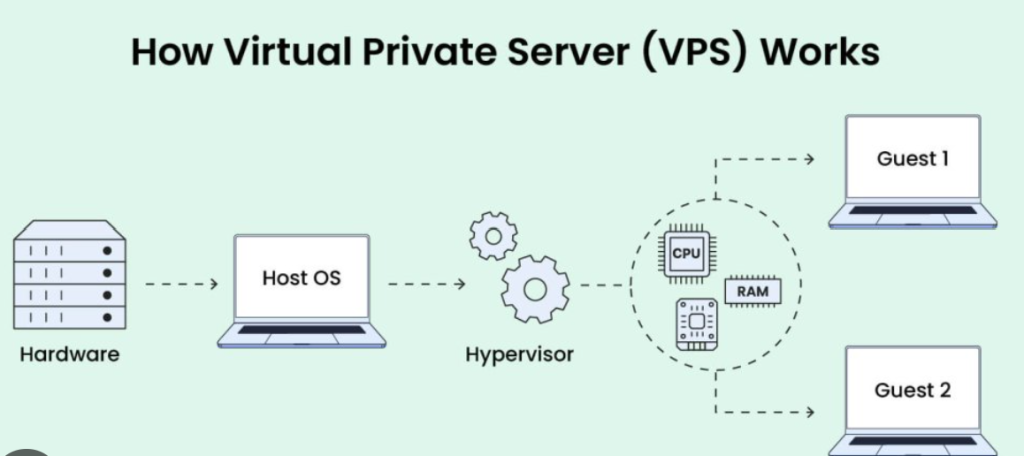
How Virtual Private Server (VPS) Work?
- Architecture: 1 physical server → Hypervisor layer → Multiple isolated VMs.
- Resource Allocation: Each VPS has its own static CPU, RAM, and storage.
- The Catch: Because all instances run on one machine, if that hardware fails, every VPS on it goes dark.
Pros: Benefits of VPS Hosting
- Dedicated allocated resources (CPU, RAM, storage)
- Full root access and control
- Better performance than shared hosting
- Cost-effective for stable workloads
Cons: Limitation of VPS Hosting
- All virtual private servers (VPS) run on the same physical hardware
- If the physical server experiences hardware failure, all virtual private servers on it are affected
- Scaling often requires manual upgrades or migration
- Resource limits are capped by the host machine
What is VPS Hosting Used For?
- Small-to-medium business websites.
- Internal testing/staging environments.
- Predictable, low-traffic CRM deployments.
Examples of VPS Hosting Providers
- Hostinger
- Exabytes
- Shinjiru
- GoDaddy
- Namecheap
- ServerFreak
In short: VPS hosting provides isolation — but not infrastructure redundancy.
What is Cloud Hosting?
Cloud hosting is a virtualized infrastructure built on a cluster of interconnected physical servers working together as a unified resource pool. Instead of relying on a single physical machine, your workloads are distributed across multiple servers, providing redundancy, automatic failover, and scalable resources.
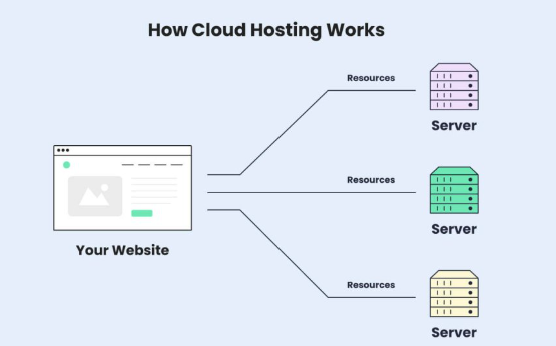
How Does Cloud Hosting Work?
- Architecture: Multiple physical servers → Resource pooling → Load balancers → Distributed storage → Automatic failover
- Resource Allocation: CPU, RAM, storage, and network resources are dynamically allocated from a shared pool based on demand.
- The Catch: While cloud infrastructure is highly resilient, misconfigured deployments or poor application optimization can still affect performance. Proper architecture planning is essential.
Pros: Benefits of Cloud Hosting
- High availability with automatic failover
- Dynamic, on-demand scalability (vertical & horizontal)
- Handles traffic spikes without slowing down
- Distributed storage ensures data redundancy
- Pay-as-you-go pricing for cost efficiency
Cons: Limitation of Cloud Hosting
- Slightly higher learning curve than VPS for beginners
- Costs can increase if resources aren’t monitored
- Performance depends on network latency and configuration
- Requires more careful management for complex deployments
What is Cloud Hosting Used For?
- Mission-critical CRM or ERP systems
- High-traffic eCommerce platforms
- SaaS applications and client portals
- Applications requiring redundancy, disaster recovery, and uptime guarantees
Examples of Cloud Hosting Providers
- IP ServerOne
- AWS
- Azure
- Google Cloud
- Alibaba Cloud
- Vultr
- DigitalOcean
In short: Cloud hosting provides elasticity, redundancy, and resilience.
2026 Technical Comparison: VPS Hosting vs. Cloud Hosting for Malaysian SMEs
| Feature | VPS Hosting | Cloud Hosting |
| Architecture | Runs on a single physical server partitioned into virtual slices. | Runs on a distributed cluster of multiple physical servers. |
| Hardware Dependency | Single point of failure. If the host server breaks, your VPS goes down. | High Availability. If one node fails, workloads shift to another automatically. |
| Scalability | Static. Scaling is limited by the host machine and often requires manual upgrades. | Elastic. Instant vertical/horizontal scaling to handle sudden traffic spikes. |
| Performance | Stable for predictable workloads but may struggle under unexpected spikes. | Optimized for high concurrency and variable traffic loads. |
| Reliability | Higher risk; depends on the health of one specific machine. | Built for business continuity with automatic failover. |
| Pricing Model | Fixed monthly cost. Predictable and usually offers a lower entry price. | Usage-based (Pay-as-you-go). Costs scale up or down with your actual demand. |
| Best Suited For | Company websites, dev environments, and internal tools with steady traffic. | E-commerce, SaaS, CRM/ERP systems, and mission-critical applications. |
Is Cloud Hosting Faster Than VPS Hosting?
Generally, yes—especially under load. While a VPS hosting can be snappy for a single user, its performance degrades once traffic hits the “ceiling” of that specific hardware. Cloud hosting like NovaCloud by IP ServerOne scales dynamically to maintain speed during traffic spikes.
Expert Insight: At IP ServerOne, we’ve observed that SMEs migrating from VPS hosting to NovaCloud see a 30-40% improvement in application responsiveness during peak business hours due to our cloud architecture.
Why Malaysian SMEs are Moving to NovaCloud Hosting by IP ServerOne
Global “Hyperscalers” (AWS, Azure) are powerful, but they present three major hurdles for local businesses:
- Currency Volatility: Your hosting bill changes every month based on the USD/MYR rate.
- Complexity & Bill Shock: Hidden “Egress Fees” (data leaving the cloud) can double your expected cost.
- Support Gap: When your ERP goes down at 10 AM in Kuala Lumpur, you don’t want to wait for a support team in a different time zone.
The NovaCloud Hosting Advantage:
- Data Sovereignty: Your data stays in Malaysia, compliant with local PDPA and security standards (ISO 27001, ISO 27017, PCI-DSS, SOC 2 Type II).
- 24/7 Local Expertise: Real engineers, reachable via phone or chat, who understand the local business landscape.
- No Hidden Fees: Unlike global providers, we offer transparent pricing with predictable bandwidth costs.
- Disaster Recovery: Automated hourly/daily snapshots are built-in complimentary, not an afterthought.
NovaCloud Hosting Pricing
NovaCloud hosting operates on a Pay-As-You-Go model. You only pay for what you use, making it highly efficient for SMEs.
- General Compute Plans: Start from approximately RM 0.06/hour.
- Zero Upfront: No heavy capital expenditure (CAPEX); just a manageable monthly OPEX.
The Quick Verdict: Which should your Malaysian SME choose?
If you are running a static corporate website or a small internal HR system, VPS Hosting is your most cost-effective choice. It gives you dedicated resources at a fixed monthly price.
However, if you run an e-commerce store (like Shopify or WooCommerce) or a SaaS app where traffic spikes during sales like 11.11 or Payday, Cloud Hosting is the only way to ensure your site doesn’t crash. In Malaysia’s competitive digital landscape, the “pay-as-you-use” model of the Cloud often saves SMEs more money in the long run than a fixed VPS.
Ready to see the difference for yourself?
👉 Compare price for NovaCloud vs Other Providers
Frequently Asked Questions (FAQ)
Can I migrate my existing VPS hosting to IP ServerOne’s NovaCloud?
Yes. IP ServerOne provides full migration assistance to ensure a seamless transition from legacy VPS hosting to its high-availability NovaCloud environment, with minimal downtime and strong data security controls.
Is Cloud hosting more expensive than VPS hosting?
Initially, the hourly rate for cloud hosting may be slightly higher than traditional VPS hosting. However, cloud hosting often reduces total business costs by minimizing downtime risks and eliminating the need to over-provision resources for peak demand periods.
Does NovaCloud support Windows and Linux?
NovaCloud supports major operating systems, including multiple Linux distributions and Windows Server environments. This makes it suitable for ERP systems such as SAP, Odoo, AutoCount, and other custom business applications.
Is cloud hosting better for meeting Malaysia’s 2026 E-Invoicing mandates?
Yes. As Malaysia’s LHDN E-Invoicing mandate reaches full implementation in 2026, cloud hosting provides scalable processing power and high availability for API integrations. This helps businesses maintain reliable, real-time invoicing connectivity during high-volume periods and reduce non-compliance risks.
How does local cloud hosting protect Malaysian SMEs from USD currency fluctuations?
Local cloud providers such as IP ServerOne bill in Malaysian Ringgit (MYR), while many global hyperscalers bill in USD. Local billing reduces exposure to exchange rate volatility, helping Malaysian SMEs maintain predictable operational expenditure without foreign currency risk.
About the Author

Judy Lee | Marketing Manager, IP ServerOne
With over 12 years of experience spanning healthcare, hospitality, and cloud technology, Judy Lee specializes in translating complex infrastructure into clear, practical business solutions. She believes technology should feel enabling—not intimidating—and is passionate about turning “cold” systems into reliable, human-centered support for the people who depend on them. Today, she helps Malaysian businesses scale with confidence by navigating AI adoption, data sovereignty, and digital transformation in a rapidly evolving digital landscape.